20051118

Averatec Notebook Review


CNET took a look at the 3715 from Averatec, makers of "no frills" budget notebooks.
By today's thin-and-light standards, the Averatec 3715's smallish 12.1-inch display, with its low 1,024x768 (XGA) native resolution is unimpressive--more expensive thin-and-lights often have higher-resolution wide-screen displays--yet it's sufficient for doing work on the road. The two speakers, placed underneath the laptop, emit typically mediocre sound.

For a thin-and-light, the Averatec 3715 offers a good selection of ports, jacks, and slots. A four-pin FireWire port, a Type II PC Card slot, a 4-in-1 flash-memory card slot, a 56K modem jack, and an Ethernet jack line the left edge alongside the system's built-in DVD burner. The opposite edge includes a VGA port and three USB 2.0 ports, at least one of which should have been placed on another edge for more flexibility. Finally, headphone and microphone jacks sit on the front edge.

The Averatec 3715 ships with the Windows XP Home operating system, plus a handful of CyberLink multimedia apps for burning and viewing discs. As you'd expect from such an economical system, the Averatec 3715 lacks a productivity suite.

A thousand bucks won't buy a bunch of top-notch laptop components, so it makes sense that the Averatec 3715 carries a low-budget AMD Sempron 3000+ processor, 512MB of slow 333MHz memory, and an integrated VIA S3G chipset that borrows 32MB of main memory to use as VRAM. Even so, Averatec throws in a single-layer DVD burner, 802.11b/g wireless, and a big (albeit slow) 80GB, 4,200rpm hard drive.

From the $950 price tag, it's not really a bad deal if you want something light, and with a bigger hard drive, and DVD writer. It's a much better deal than the $500 notebooks Dell is selling with a 30 GB hard drive, and a read only DVD drive. I think CNET was a little hard on it.

It's Official....


Bloggers are journalists. Where do I pick up my press credentials?

"The Federal Election Commission today issued an advisory opinion that finds the Fired Up network of blogs qualifies for the 'press exemption' to federal campaign finance laws. The press exemption, as defined by Congress, is meant to assure 'the unfettered right of the newspapers, TV networks, and other media to cover and comment on political campaigns.' The full ruling is available at the FEC site. A noteworthy passage: '...an entity otherwise eligible for the press exception would not lose its eligibility merely because of a lack of objectivity...'"

New Creative MP3 Players


It looks like the latest efforts from creative are flash based, and not hard drive based. With more users having more songs, I doubt that flash will provide the capacity needed. Personally, I'm looking for bigger, not smaller!

Creative is pumping out a new line of their Zen Neeon, this time outfitted with lower capacity flash, maybe to compete with the Nano — but since they don’t offer a 4GB option and no color screens are in sight, it looks like they’ll have to wait ‘till next time to play with the big boys. A hard-drive based option is still hanging around, now bumped up to 6GB and offering up 7 selectable backlight colors, but only has a 16 hour battery. The flash players, coming in 512MB, 1GB, and 2GB flavors, feature feature a 2 color OLED display and double your fun with 32 hours of battery. Everybody is bringing FM radio, voice recording, and line-in capabilities to the party, and the prices that range from $122 to $205 for the flash players and $216 for the 6GB HD player. Of course, the real story here is the new decorative skins — nothing like some random Japanese art to keep us coming back, Creative!

Pentop Computer


They spent $100 million developing this device for children. It seems to have a lot of potential applications. For $100, it may sell well this holiday season. I'd like to see a more adult version though.

"There's something a little odd about the term "pentop computer." Terms like laptop, palmtop and desktop tell you where you use the computer - but you don't use the Fly on top of a pen.

Instead, the Fly is a pen - a fat ballpoint pen. (The company says that its focus groups found the term "pentop computer" infinitely sexier than "pen computer." Nobody ever said consumers are logical.)

The Fly is so fat because it contains an AAA battery, a computer chip, a speaker and, mounted half an inch from the ballpoint tip, a tiny camera. For all of its educational, interactive tricks, the Fly pen requires special paper whose surface is imprinted with nearly invisible micro-dots. As you write, the pen always knows where it is on the page, thanks to those dot patterns and the camera that watches them go by.

Logitech and other companies sell exactly the same technology to adults, but it's never caught on. Those pens simply store what you write - not as text, but just as a frozen graphic - and later transfer it to a Windows computer.

But Fly's maker, LeapFrog (maker of LeapPad, the popular interactive book reader), has much greater ambitions. In its incarnation, which is aimed at "tweens" (8 to 14 years old), no PC is required or desired; instead, you get crisp, instantaneous audio feedback from the pen's speaker."


From the NY Times.

Sony & NEC


It looks like optical drive nuptials are happening. Does this make LiteOn, Sony's former drive maker, "the other woman?"

Sony and NEC have concluded a basic agreement to merge their optical-disc drive businesses into a new company, the companies have announced.

The two companies hope to launch the new venture on April 1, 2006, which is the first day of the new financial year in Japan. Sony will hold a 55 percent stake in the as-yet-unnamed company and NEC will hold the remaining 45 percent stake, according to the terms of a memorandum of understanding signed by the companies.

The new joint venture will work on planning, design, manufacturing, and marketing of optical-disc drives for products such as personal computers and DVD players, they said in a statement. In the next-generation optical disc market the company will manufacture drives for both the HD-DVD format, of which NEC is a major backer, and Blu-ray Disc, of which Sony is a leading supporter, both companies said.

20051117

Ritek's Latest


Another iPod fighter enters the fray, this one due out at the CES in January.

“The addition of the OLE 8100 MP4 player to our RIDATA family is
further evidence of our commitment to provide our customers with the
latest in portable digital-oriented products,” stated Harvey Liu,
Advanced Media Inc. president. “With audio, video, and photo-viewing
capabilities, it offers users phenomenal flexibility in when and where
they enjoy their media of choice.”

MP4 is the latest compression standard developed by the Moving Picture
Experts Group (MPEG). Formally known as MPEG-4, it was designed to
store and deliver both professional-grade audio and video streams.

The RIDATA OLE 8100 supports the following formats – music: MP3,
WMA, OGG, AC3; video: AVI, MPEG-1,2, and 4, VOB, DAT; and photo: JPG,
YUV (up to 4800 x 3600), support picture preview/slide function. Video
and photos are displayed on an energy-efficient 2″ LTPS LCD panel.

It features five-mode equalization (normal, rock, jazz, classical, and
pop), three playing modes (normal, repeat one, and repeat all), and
both digital voice and line-in recording capability.

With its embedded solid-state NAND flash memory, the OLE 8100 can
perform up to one-million erase/rewrite operations. 1GB and 2GB
capacities are available. The 2GB model provides up to 3.5 hours of
video play time and over 3 hours worth of audio.

The unit supports WIN98SE/ME, WIN2000, and WINXP operating systems.
Video output to NTSC or PAL standards is by the included A/V cable.
Video output ports are RCA and S-tunnel. A/V input/output ports include
MIC in, line-in in, earphone out, and A/V out. A USB 2.0 PC interface
is also included.

The RIDATA OLE 8100 MP4 player is packaged with an earphone, USB cable,
audio output cable,
S-terminal/RCA video cable, installation CD, audio line-in cable, AC/DC
universal charger, and a user’s manual.

The compact, pocket-size unit is 2.6″ x 2.6″ x 0.75″ and weighs less
than 3 ounces. It comes with Advanced Media’s quality promise and
one-year warranty.

It looks intriguing, and I like the idea of both MP3 and WMA, as well as JPEG and MP4 support.

20051116

Wireless Speakers Reviewed


This is the 1st review of a product that got a lot of attention a few months ago. With the ability to have rear speakers, with no wires, this speaker set has a really unique feature. Take a look if you've got $500 to spare.
The Z-5450 is a very good speaker system, powerful and capable of being adapted to a multitude of uses. It also scores points by virtue of its system of cordless connection to the rear satellites, which is a very practical feature. However, you have to realize that cutting these two cables comes at a price. This will be the weak point of this system, the balance between its market price and the importance that you give to this distinguishing feature. If cables don't annoy you particularly then be patient; Logitech will be releasing the wired equivalent of the same system a little later; the Z-5400 will have a substantially lower price - $299 instead of $499. Still, for the moment, if quick results are the order of the day, the increased price of the 5450 isn't excessive...

20051115

18x DVD+R Planned


I didn't see this one coming...
Optical drive enthusiasts are definitely impatient people. Why else would they constantly remove a perfectly functional piece of computer hardware (namely their optical drive) to swap in one that is just a little faster? First it was CDR speeds, then DVDR speeds, and lately DVDR dual layer speeds. DVDR disc writing speeds maxed out at 16x a year ago. A full DVDR disc could be cooked in 6 minutes, and no one expected any faster as rotational speeds maxed out.

Well, counting on the fact that we always want things one notch faster, Plextor is planning on introducing a DVD writer that can write DVD+R discs at the breakneck speed of 18x! Personally, I think this is very fast, will probably put the hit on write quality, and can’t wait to try it.

20051114

On NOT buying an iPod....


The new iPod is an awesome music player, and is selling very well. Apple's player has a color screen, decent battery life, and is flash memory based, avoiding any hard drive issues. For many folks, it's a no brainer of a choice, especially given its great form factor.
So, I went down to my local Best Buy to check out some portable devices with more storage space. After looking at all of the choices, I narrowed it down to the Creative Zen Micro and Apple iPod Nano. Seriously, I had been leaning towards an iPod after talking with Michael and Matt, two Microsoft Media Center employees who own iPods.

The Apple iPod Nano had a color screen and came in 2GB ($199) and 4GB ($249) versions based on flash memory technology. The Nano is super thin and light -- 1.5 ounces at 1.6 x 3.5 x 0.27 inches. I'm used to replacing the AAA batteries in the Muvo, so this feature is actually something to which I've grown accustomed. Based on everything I've read, the battery issues with iPods are a thing of the past, so I'm not concerned there. Anyway, the battery doesn't appear to be end user replaceable in the iPod Nano. The Apple website has gobs of information on how to care for and extend battery life, but apparently if you need to replace the battery you must send it in to be serviced. You can see album art with the Nano, but according to a conversation with my friend Michael I'll need third party tools to take my medium sized collection of already ripped WMA files and convert them to MP3, then get the album art. He tells me iTunes won't fetch album art for any music already in my collection, but does for tracks purchased through the iTunes Music Service. The Nano has lot's of wow factor, and would be an obvious draw for many people.

However, for the author of the piece, he actually bought a Creative product. Interestingly, he needs to blog us to explain his choice over the Apple iPod. In the end, I think he made a good, and informed choice.

Mediocre Travel Router Reviewed


While on the road with your notebook, a travel router is a great idea. When in a less than ultra luxury hotel (aka: budget, ie: Motel 6), it's great to not be tethered to the short cord the motel provides. Enter, the travel router which promises to let you take your notebook to the bed, the patio, and even the bathroom. However, CNET was not in love with the APC model tested.
When you're kicking it in your hotel room after a long day on the road, the last thing you want to do is sit at the room's uncomfortable desk, close to the Ethernet jack, to check your e-mail. APC's 3-in-1 Wireless Mobile Router can transform that jack into a wireless hot spot, letting you lie in bed while working online. Toting this small, light device along on your travels is easy, and its support for WPA, SPI firewall, and VPN capabilities helps your data remain secure. There's just one problem: the 3Com Office Connect Travel Router offers all of this--plus easier setup, better range, and a longer warranty--for the same price

20051113

WiFi Detector


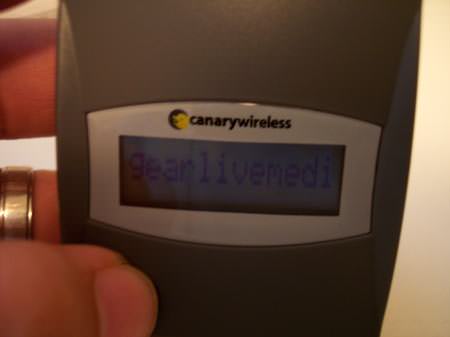
I personally like the zyXEL unit as it detects 802.11a signals as well, and it displays all the info about a hotspot on one screen, but this unit is an alternative.

Walking around, it was way more convenient to break out the Digital Hotspotter with the one-button operation and all. No need to stop, open up the PowerBook, and search for a signal. However, I found another nice benefit. Since the Hotspotter tells you the channel of any network you are near, you can use this to your advantage in your home. If you find a neighbor is on channel 1, and another is on channel 3, you know to set yours up near 11 so reduce interference. This is one device we are recommending to anyone that uses Wi-Fi. It’s simple - but it’s that good. You can pick one up for about $50 USD, and the batteries last for about two months

Tiny Memory


These USB flash drives are getting ridiculously small! So teeny, that your data will be too easy to lose. This device is based on the microSD memory standard. it's hard to believe they can pack 2 GB in there!
"The Super Stick weighs only five grams and measures 39x12x2 mm. The size may somehow have its disadvantages, because the Super Stick might get lost very fast in your pockets, or, who knows, in somebody else's pocket.

The tiny gadget is based on the microSD technology, dubbed as the smallest flash memory on the market, close in size to the RSMMC technology. The stick uses USB 2.0 interface and offers really good transfer speeds: 20 MB/s, both writing and reading. The capacities of the Super Stick range from the entry-level 256 MB to the “too big for its size” 2GB."


From Softpedia

20051111

And the winner for the best use of aluminum foil is...


Me thinks these folks have a little too much time on their hands....
What do you do when the president of your company says the department that pulls the best prank will win $100 each? Cover an entire office in aluminum foil. That’s right. All the walls, all the furniture, all his office equipment, every paper clip and even the sticky notes on his desk. We aim to never be outdone, and this was no exception.

Needless to say, the won, hands down.

MP3 Knows When Not To Play


Too many gadgets may be the latest problem some of us face. How can you take that phone call while wearing your music player's headphones. Technology to the rescue to help solve the problems it creates. This music player turns off to allow you to take the call with the Bluetooth headephones.
SigmaTel, a developer of mixed-signal multimedia semiconductors, is helping portable music player maker FunTwist to cut clumsy wired headphones. The new FunTwist D-Chord800 digital audio player promises high-quality digital music performance in multiple formats wirelessly via a Bluetooth link that switches to phone mode when it detects an incoming call.

Just one word: AWESOME!

Better Traffic Monitoring


Let's face it: everyone has been stuck in traffic at some point. My favorite is when you're bumper to bumper under a sign the traffic sign that say "normal traffic conditions ahead." While that may be "normal" for 8 am going into Manhattan, that's hardly useful information. there just has to be a better way. the latest idea is that the traffic could be monitored using cell phones.
Several state transportation agencies, including those in Maryland and Virginia, are beginning to test technology that allows them to monitor traffic by tracking cellphone signals and mapping them against road grids. The technology highlights how readily cellphones can become tracking devices for companies or government agencies - a development that troubles privacy advocates.

These new traffic systems can monitor several hundred thousand cellphones at once. The phones need only be turned on, not in use. And sophisticated software now makes it possible to discern whether a signal is coming from, say, a moving car or a pedestrian.

State officials say the systems will monitor large clusters of phones, not individual phones, and the benefits could be substantial. Source: International Herald Tribune